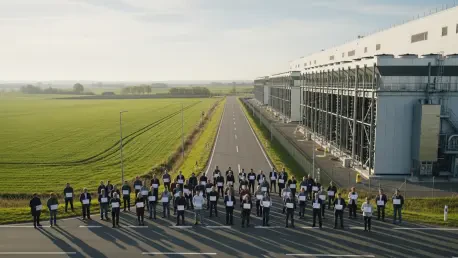

The hum of thousands of server racks echoed through rural landscapes until a coordinated wave of demonstrations on July 18, 2026, shattered the quiet as protesters across 42 states rallied against the unchecked expansion of artificial intelligence infrastructure. Spearheaded by the organization HumansFirst and led by veteran political organizer Amy Kremer, these 142 separate events mirrored the grassroots intensity of previous populist movements that have defined American political history. The protests aimed to provide a powerful voice to local communities that feel increasingly sidelined by the aggressive and often opaque expansion of Big Tech corporations. This mobilization signals a new era of political friction over the physical requirements of the digital age, as the general public begins to reckon with the environmental and social costs of the AI revolution. For many, the movement represents a critical stand against a future where local autonomy is sacrificed for the sake of technological speed and corporate profit.
Public Anxiety and Regional Friction
Core Grievances: Impact on Local Landscapes
Recent polling underscores a deep-seated skepticism toward the current pace of AI growth, revealing that only a small fraction of the American public supports the construction of new data centers within their immediate neighborhoods. In states like Virginia and Georgia, where the concentration of digital infrastructure is highest, demonstrators voiced specific alarm over the hyperscale nature of these projects. These massive buildings are criticized for consuming millions of gallons of local water daily to cool high-density server racks, threatening the availability of resources for residents. The friction is particularly acute in rural areas, where quiet landscapes are being converted into industrial corridors with little notice. Consequently, the movement is framed as a struggle for local liberty and the protection of natural resources from multinational entities. Protesters demand that environmental impact studies be made public and that local water rights be prioritized over industrial cooling needs.
Geographic Distribution: From Texas to California
The movement’s reach spans the political spectrum, drawing significant crowds in both traditional tech hubs and rural battleground states. Texas led the nation in activity, while protesters in California’s Imperial County faced extreme heat to oppose projects threatening the Colorado River’s water supply. This nonpartisan backlash brings together environmentalists and conservative activists, demonstrating that the physical footprint of AI is a rare issue that unites diverse demographics against a common perceived threat. In the Pacific Northwest, similar concerns have been raised regarding the impact of data center energy consumption on hydroelectric power costs. The broad geographic distribution of these protests signals that the physical footprint of the digital age is no longer a niche concern but a national priority. Activists in these regions are increasingly calling for state-level legislation to cap resource usage and ensure that the expansion of the cloud does not come at the cost of local ecology.
Organizational Strategy and Industrial Outlook
Tactical Approaches: Accountability and Advocacy
While the rhetoric remains sharp, the movement focuses more on corporate accountability and transparency than on calling for outright government bans. Participants include a wide array of political nomads and local advocates who prioritize the economic and environmental health of their regions over partisan loyalty. Rather than seeking a total halt to construction, many organizers are pushing for a seat at the table to ensure that development does not happen behind closed doors or at the expense of local voters. Their primary demand is for a more inclusive planning process that requires tech companies to disclose the full extent of their resource consumption before construction begins. By emphasizing the need for transparency, the movement seeks to empower local governments to negotiate better terms, such as requiring developers to fund infrastructure upgrades. This tactical approach shifts the debate from a pro-growth binary to a discussion about responsible and equitable industrial development.
Long-Term Outlook: Strategic Industry Shifts
In response to the unrest, industry representatives defended their practices, claiming that data centers were essential to modern life and placed less strain on resources than other industrial sectors. Nevertheless, the tension between technological progress and community preservation became a pivotal talking point as the 2026 midterms and 2028 presidential election approached. HumansFirst laid out clear demands for future development, focusing on guaranteed environmental protections and the creation of high-paying union jobs. Policymakers began to consider national standards for data center resource efficiency, suggesting that future projects would require a higher level of social license. For the industry, the path toward successful expansion moved away from simple land acquisition toward building genuine partnerships with local stakeholders. Local governments implemented stricter zoning laws to prioritize resource conservation, ensuring that the growth of AI did not cost essential public utilities.