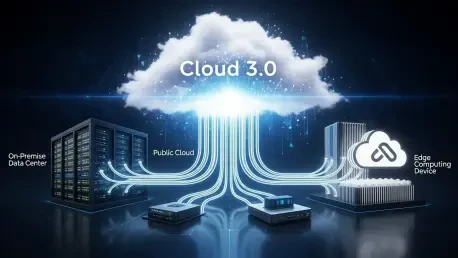

Corporate boardrooms across the globe are no longer signing off on unchecked cloud migration budgets as the realization sets in that the public cloud is not a magic solution for every operational inefficiency. While the initial promise of digital transformation revolved around the mass migration of legacy systems to hyperscale providers, the current landscape has evolved into a more sophisticated and discerning phase known as Cloud 3.0. This new era represents a fundamental transition from a “cloud-first” to a “cloud-right” philosophy, where the placement of workloads is determined by specific business outcomes, regulatory requirements, and economic sustainability rather than a reflexive desire for modernization. Organizations are now treating the cloud not as a singular destination, but as an operating model that encompasses a distributed ecosystem of public services, private infrastructure, and localized edge computing nodes. This shift is driven by a growing awareness that a centralized approach often leads to unforeseen complexities and escalating costs that can stifle innovation if left unmanaged. Consequently, the industry is seeing a resurgence in the value of owned hardware and dedicated private environments that work in tandem with the public sector to create a balanced, high-performance foundation for the modern enterprise.
The Evolution of Cloud Strategies: Moving Beyond Migration
The historical progression of cloud adoption followed a path that began with the reactive strategies of Cloud 1.0, which was characterized by the “lift and shift” of virtual machines to remote data centers. During this initial phase, the primary motivation for most enterprises was the reduction of capital expenditures and the desire to offload the burden of physical hardware maintenance to third-party providers. While this move provided immediate relief for IT budgets and improved basic scalability, it often resulted in inefficient architectures that did not take full advantage of cloud-native capabilities. As companies grew more comfortable with remote environments, they transitioned into the Cloud 2.0 era, where the focus shifted toward building applications specifically for the cloud using microservices, containers, and serverless computing. This stage allowed for much faster software delivery cycles and more granular control over application performance, but it also introduced a level of fragmentation and service sprawl that became increasingly difficult for IT teams to manage effectively at an enterprise scale.
As the industry matures into the Cloud 3.0 phase, a phenomenon known as “cloud fatigue” has emerged among technology leaders who are grappling with the long-term consequences of these earlier adoption stages. The initial enthusiasm for a total shift from Capital Expenditure to Operational Expenditure has been tempered by the reality of spiraling monthly invoices that are often difficult to predict or justify to stakeholders. Many organizations have discovered that while the public cloud is excellent for elastic and unpredictable workloads, it can be prohibitively expensive for steady-state operations that require consistent resources over several years. This realization has prompted a strategic re-evaluation of the digital estate, leading many firms to repatriate certain workloads to private clouds or high-performance on-premises facilities. By doing so, they can regain financial control and ensure that their infrastructure spending is directly aligned with the value each application provides to the business, rather than being a byproduct of architectural convenience.
Economic Pressures: Solving the Cost and Sovereignty Crisis
One of the most significant catalysts for the move toward hybrid infrastructure is the growing concern over the hidden costs associated with centralized public environments, particularly regarding data egress fees. Hyperscalers often provide an attractive entry point for data storage, but the financial penalties for moving that data back to a local environment or to another provider can be astronomical. For data-intensive industries such as media, healthcare, and finance, these egress charges create a form of gravity that makes it nearly impossible to maintain a flexible multi-cloud strategy without a robust private core. By maintaining a hybrid model, companies can store their primary data sets in cost-effective private repositories while only utilizing the public cloud for specific processing tasks. This approach allows for a much higher degree of financial predictability and prevents the organization from being held hostage by the pricing structures of a single vendor, thereby improving overall fiscal health.
In addition to economic concerns, the rise of stringent data sovereignty and privacy regulations has made the hybrid model a legal necessity for many global enterprises. Laws such as the General Data Protection Regulation and various national security mandates require that sensitive information remain within specific geographic borders or under the direct control of the organization. Public cloud providers, while offering regional availability zones, may not always satisfy the most rigorous interpretations of these requirements, especially when data is subject to cross-border access by foreign governments. A hybrid infrastructure allows IT leaders to keep critical and regulated data on-premises or in localized hubs while still leveraging the public cloud for non-sensitive, global operations. This dual-layered strategy ensures that the business remains compliant with evolving international laws without sacrificing the agility and reach that modern digital services require to compete in a global marketplace.
The strategic risk of vendor lock-in has also become a primary concern for executive leadership teams who recognize the vulnerability of relying on a single infrastructure provider for their entire operation. Major service outages, sudden price hikes, or shifts in a provider’s service-level agreements can have devastating effects on a company that has no alternative foundation for its digital services. Building a hybrid environment provides a level of architectural independence that allows for a more resilient and competitive posture. By distributing workloads across multiple platforms and maintaining a capable private infrastructure, organizations can leverage their diverse ecosystem to negotiate better terms with vendors and ensure that their operations remain functional even during significant provider disruptions. This diversification of technical debt is now seen as a hallmark of a mature enterprise, providing a safety net that protects the business against the inherent risks of a centralized digital strategy.
The Impact of Artificial Intelligence: Navigating Compute Gravity
The explosive growth of generative artificial intelligence has fundamentally altered the requirements for modern infrastructure, introducing the concept of “compute gravity” to the enterprise landscape. Training and running large language models requires an unprecedented amount of processing power, primarily delivered through high-performance GPUs that are both expensive and in high demand. While public cloud providers offer access to these resources, the sheer scale of the compute required for modern AI applications often makes leasing them indefinitely a poor financial decision. Many forward-thinking organizations have begun to invest in their own private AI clusters, allowing them to benefit from a more predictable cost structure and better performance optimization for their specific workloads. This hybrid approach enables firms to use the public cloud for rapid experimentation and prototyping while moving established, resource-intensive models to private hardware for long-term production.
Security and the protection of intellectual property are also driving the move toward hybrid setups in the AI sector. Companies are increasingly wary of training their proprietary models on shared public infrastructure where there is even a theoretical risk of data leakage or unauthorized access to sensitive training sets. By utilizing a hybrid infrastructure, a business can maintain a secure, air-gapped environment for its most valuable data assets while still taking advantage of the pre-trained models and developer tools available in the public cloud. This ensures that the organization can innovate at the pace of the market without compromising the competitive advantages found in its unique data. Furthermore, keeping AI training local reduces the latency and costs associated with moving massive datasets into the cloud, creating a more efficient pipeline for the development and deployment of machine learning applications that are critical to future growth.
Strategic Implementation: Portfolio Management and Resilience
The transition to a hybrid Cloud 3.0 model requires IT leaders to adopt the mindset of a portfolio manager who balances various assets based on their specific risk, cost, and performance profiles. Instead of viewing infrastructure as a generic commodity, organizations are now categorizing workloads into “steady-state” and “elastic” buckets. Steady-state tasks, which have predictable resource requirements over long periods, are often better suited for owned hardware where the total cost of ownership is significantly lower than a public cloud subscription. Conversely, elastic workloads that experience sudden spikes in demand, such as seasonal retail traffic or short-term marketing campaigns, remain the perfect use case for the hyperscale environment. This nuanced approach ensures that every dollar spent on infrastructure is optimized for the specific needs of the application, resulting in a more efficient and effective IT organization that can support a wider range of business initiatives.
Operational resilience has also emerged as a cornerstone of the hybrid strategy, providing a necessary level of business continuity in an increasingly digital world. By distributing resources across geographically diverse locations and different platform types, companies can create a self-healing environment that is capable of withstanding local disasters or systemic failures. A hybrid model allows for seamless failover capabilities, where critical applications can be shifted from a public cloud to a private data center or vice versa in the event of an emergency. This level of redundancy is no longer considered a luxury but is a mandatory requirement for enterprises that depend on 24/7 availability for their global customers. The ability to maintain operations under any circumstances not only protects the company’s reputation but also prevents the massive financial losses that are commonly associated with modern service downtime and infrastructure outages.
Future-Proofing Operations: Automation and Unified Governance
Effectively managing the complexity of a hybrid, multi-cloud environment demanded the implementation of a “single pane of glass” to unify disparate systems and security protocols. Without a centralized management layer, IT departments faced the risk of dangerous fragmentation, where different teams operated in silos using incompatible tools and varying security standards. The adoption of modern management platforms allowed for the enforcement of consistent policies across the entire digital estate, regardless of where the physical hardware resided. This unified governance model enabled organizations to monitor their total cloud spend through rigorous FinOps disciplines, ensuring that every resource was utilized efficiently. By integrating automated monitoring and compliance checks, businesses were able to identify and rectify anomalies in real-time, significantly reducing the operational overhead that previously plagued hybrid deployments and allowing for a more streamlined approach to resource allocation.
The industry eventually moved toward a more mature understanding of infrastructure, where success was measured by business outcomes rather than the simple act of cloud migration. Organizations that embraced the Cloud 3.0 paradigm found that they could achieve a superior balance between the agility of the public cloud and the control of private infrastructure. This transition required a fundamental cultural shift toward automation-first engineering, where manual provisioning was replaced by standardized code that could deploy applications across any environment with minimal human intervention. Those who successfully navigated this shift discovered that their IT departments functioned more as strategic partners than as cost centers, providing the flexible foundation necessary for continuous innovation. By prioritizing architectural diversity and long-term sustainability, these enterprises built a resilient digital foundation that remained highly adaptable to the evolving technological landscape and the unforeseen challenges of a volatile global market.