
Maryanne Baines has spent her career at the intersection of high-scale cloud infrastructure and the silicon that powers it. As a leading authority in evaluating tech stacks for global enterprises, she offers a unique perspective on how hardware architecture dictates the ceiling of software potential. Today, we sit down with her to explore AMD’s latest hardware offensive—the Helios AI architecture and the Instinct MI455X GPUs—which signal a pivot toward fully integrated, rack-scale solutions designed for the most demanding “AI factories” in the world.
Our conversation explores the structural integration of CPUs, GPUs, and networking within the Helios framework, while also analyzing the raw performance benchmarks of the new MI400 series. We examine how these hardware advancements translate into tangible advantages for cloud providers, the strategic importance of the software-hardware co-design, and why industry giants are moving toward this end-to-end ecosystem.
The Helios architecture integrates CPUs, GPUs, and networking into a single rack-scale “AI factory,” but how does this shift toward an end-to-end solution actually change the game for data center operators?
Moving to a full rack-scale architecture is a massive leap forward because it eliminates the friction of piecing together disparate components from different vendors. When you look at Helios, you are seeing a co-designed engine where 6th Gen AMD Epyc server CPUs, Instinct GPUs, and Pensando networking are optimized to work as a singular, cohesive unit. This integration allows the system to scale up to 260TB/s bandwidth and host 72 GPUs on one single domain, providing a visceral sense of power that fragmented systems simply cannot match. For an operator, this means less time troubleshooting interoperability and more time pushing the limits of what their models can achieve.
AMD has made some bold claims regarding how Helios compares to its primary competition, specifically Nvidia’s Vera Rubin NVL72; what specific metrics stand out to you as the most significant?
The most striking numbers come down to the sheer volume of data the system can move and process simultaneously. According to the latest data, Helios offers 15% more AI compute and a staggering 50% more memory and scale-out bandwidth than the Vera Rubin NVL72. In a production environment, that 50% increase in bandwidth is the difference between a system that flows and one that chokes under the pressure of massive datasets. It is not just about raw speed, but the ability to maintain that performance across a massive scale, which is why AMD is positioning this as the world’s highest-performing rack.
At the core of this system is the new Instinct MI455X GPU, which has been described as the “engine” of the rack; what are the technical specifics that allow it to handle such high workloads?
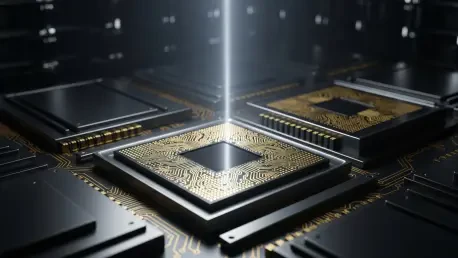
The MI455X is a beast of an accelerator, delivering a peak of 40 petaflops of FB4 compute, which is a level of throughput that was once hard to imagine for a single GPU. It features an expanded HBM4 capacity and 423GB of HBM core, supported by a peak memory bandwidth of 23.3 terabytes per second. These specifications are specifically tuned for expanded AI formats, ensuring that the “engine” can keep up with the rapid evolution of model architectures. When you see these GPUs in action, you realize they aren’t just incremental upgrades; they are foundational shifts in how we approach high-frequency compute.
Beyond the GPUs, the Helios rack utilizes 6th Gen Epyc CPUs and Pensando networking; how do these components support the overall performance without becoming bottlenecks?
The 6th Gen AMD Epyc server CPUs are critical here, providing 96 high-frequency cores that act as the steady hand guiding the massive GPU throughput. With 1.6TB/s of memory bandwidth at the CPU level and the inclusion of the UALoE networking fabric, the system ensures that data moves through the pipes without the typical lag associated with high-scale deployments. This synergy between the Epyc processors and Pensando networking is what allows the system to scale so efficiently across its domains. It creates a balanced ecosystem where no single component is left waiting for data, maximizing the utilization of every dollar spent on hardware.
With major partners like OpenAI, Meta, and Microsoft already pledging to deploy Helios, what is your forecast for how this architecture will influence the competitive landscape of AI hardware over the next few years?
I expect we will see a significant shift in how enterprises calculate value, moving away from simple performance metrics toward a “tokens per dollar” focus that AMD is currently driving. As these massive players like Oracle and Microsoft integrate Helios into their clouds, the pressure on competitors to provide a similarly integrated and co-engineered stack will become intense. We are moving out of the era of experimental AI and into a phase of industrial-scale production where the efficiency of the “AI factory” is the only metric that truly matters for the bottom line. The success of Helios will likely force the entire industry to prioritize these end-to-end solutions over individual chip performance.