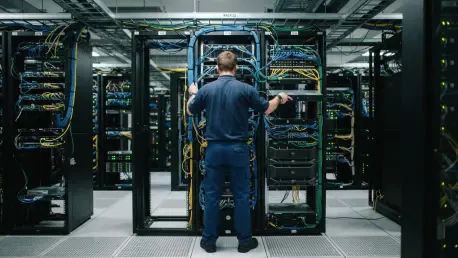

By developing custom Trainium and Inferentia silicon, AWS aims to drastically reduce the high costs associated with running live AI models at scale. This initiative is the spearhead of a broader, more aggressive campaign to push Amazon Web Services into a new stratosphere of financial performance, targeting a trillion-dollar annual revenue milestone. As the global digital landscape shifts toward a post-migration era, the focus has moved beyond mere storage to the intricate orchestration of intelligence. CEO Andy Jassy has articulated a ten-point strategic plan that positions the company not just as a participant in the AI revolution but as its primary architect. The scale of this ambition is reflected in the staggering capital expenditure commitment, which is currently hitting $220 billion to build out the necessary physical and digital foundations. This is not a reactive expansion but a proactive land grab in the burgeoning AI economy, where the winners are defined by their ability to provide the underlying utility for every digital interaction. By leveraging two decades of operational experience, the organization is betting that the convergence of massive compute power and proprietary software will create an impenetrable moat around its ecosystem, effectively redefining what it means to be a global technology titan in the mid-2020s.
Synergistic Growth: The Convergence of Cloud and Intelligence
The cornerstone of this ambitious roadmap lies in the realization that generative artificial intelligence and foundational cloud services are no longer separate market segments but rather two halves of a singular, self-reinforcing engine. This “flywheel effect” is driven by a simple but powerful logistical reality: data has gravity. As enterprises store petabytes of proprietary information within AWS data centers, the natural inclination is to run inference and training workloads in immediate proximity to that data. Moving massive datasets across different providers or back to on-premises environments is prohibitively expensive and introduces latency that modern real-time AI applications cannot tolerate. Consequently, the existing cloud dominance of the company acts as a massive magnet for the next generation of AI initiatives. As more companies deploy generative models, they inevitably consume more core services like storage, high-speed networking, and advanced security protocols. This interdependence ensures that every dollar spent on developing new AI capabilities also serves to harden and expand the traditional cloud business, creating a compounding growth cycle that is difficult for competitors to disrupt without a comparable existing data footprint.
Moreover, the transition toward complex AI tasks such as reinforcement learning from human feedback and extensive post-training represents a significant shift in how compute resources are utilized. These processes are not one-time events but ongoing operational requirements that demand the kind of elasticity and scalability that only a hyperscale cloud provider can offer. For a business to fine-tune a large language model or integrate it with a sophisticated retrieval-augmented generation system, the underlying infrastructure must be able to spin up thousands of GPUs or custom chips instantly. AWS has positioned its infrastructure to handle these sporadic yet massive surges in demand, providing a safety net for enterprises that cannot afford to build such capacity internally. This capability moves the relationship with the customer from a simple vendor-client dynamic to one of strategic dependency. As AI becomes deeply embedded in corporate workflows, the cloud provider transitions into a mission-critical utility, similar to a power grid or telecommunications network. This level of integration is what fuels the projected 40% growth rate, as the complexity of AI workloads continues to outpace the growth of the hardware they run on, necessitating more sophisticated management layers.
Strategic Transition: Capturing Global On-Premises Workloads
While cloud computing has been the dominant narrative in technology for over a decade, a startling 85% of global IT spending still occurs within on-premises environments. This represents a massive, untapped frontier for expansion and is a primary pillar of the strategy to reach trillion-dollar revenue levels. For years, certain “linchpin” workloads, such as those involving legacy mainframes or high-security financial databases, were deemed too complex or sensitive to migrate. However, the introduction of AI-driven migration tools has fundamentally changed the calculus for technology officers. These automated systems can now analyze millions of lines of legacy code, identifying dependencies and refactoring applications for the cloud with a speed and accuracy that was previously impossible. By systematically lowering the barriers to entry, the company is targeting the world’s most conservative industries, from banking to heavy manufacturing, and bringing their core operations into the AWS fold. This transition is not viewed as a brief surge but as a prolonged migration cycle that will provide steady, predictable growth as the world slowly flips the ratio from on-premises to cloud-based systems over the next several years.
Beyond the technical ability to migrate, the shift is increasingly driven by a pressing economic and operational imperative. In a world where agility is a competitive advantage, the capital-intensive model of maintaining private data centers is becoming a liability. Transitioning to a consumption-based cloud model allows organizations to redirect their capital expenditures toward core business innovation rather than server maintenance. Furthermore, developer productivity sees a massive boost when teams can access a vast library of pre-built AI tools and serverless architectures. The most compelling argument for migration, however, is data accessibility. In an on-premises silo, data is essentially frozen, unable to be easily digested by modern machine learning models. By moving to AWS, businesses unlock the latent value of their historical data, transforming it into a training set for custom AI agents that can optimize everything from supply chain logistics to customer engagement. This realization is triggering a mass exodus from traditional IT structures, as staying on-premises now implies a deliberate choice to opt out of the AI-driven future. This sentiment is a powerful catalyst for the high-volume contracts currently being signed by Fortune 500 companies seeking to modernize their operations.
Vertical Integration: Engineering the Custom Silicon Future
To maintain its leadership in a market characterized by high hardware costs and supply shortages, the organization is pursuing a rigorous strategy of vertical integration. Central to this approach is the development of in-house custom silicon, specifically the Trainium and Inferentia chips. These processors are engineered specifically for machine learning workloads, offering a specialized architecture that general-purpose GPUs often lack. By controlling the entire stack from the silicon layer up to the application interface, AWS can deliver price-performance metrics that are unreachable through third-party hardware alone. For customers, this means the ability to run larger models for longer periods without escalating costs into the realm of the unsustainable. Driving down the cost of inference—the process by which a live AI model generates an answer—is critical for the mainstream adoption of these technologies. If it costs too much to run a query, the business case for AI collapses. By offering proprietary chips that significantly undercut the market price for compute, the company is ensuring that its platform remains the most economically viable choice for any enterprise looking to scale its AI operations beyond the initial pilot phase.
The success of these proprietary chips has reached a point where they are no longer just internal tools used to power AWS services; they are becoming a significant revenue stream in their own right. Plans are currently underway to make Trainium chips available for purchase outside the traditional AWS cloud ecosystem by late 2027, marking a pivotal shift into the global hardware market. This move allows the company to compete directly with established semiconductor giants while simultaneously providing a hedge against supply chain volatility. Parallel to this hardware success is the meteoric growth of the AI software layer, represented by services like SageMaker and Bedrock. SageMaker has established itself as the go-to environment for building and training custom models, while Bedrock offers an easy-to-use interface for deploying them at scale. These services have become the fastest-growing multi-billion dollar segments in the company’s history because they solve the problem of making AI usable for the average software developer. By bundling high-performance custom hardware with intuitive, integrated software, AWS is creating a comprehensive ecosystem that captures value at every stage of the AI development lifecycle, from the first line of code to the final inference call.
Operational Mastery: Navigating Hyperscale Capacity Requirements
Building a trillion-dollar infrastructure requires a level of operational foresight that borders on the prophetic. The scale of current demand is such that enterprise customers are no longer simply renting virtual machines by the hour; they are reserving massive, dedicated blocks of capacity that require power allocations measured in gigawatts. To accommodate this, the company has had to rethink its entire approach to capacity management. It is no longer sufficient to react to demand as it arises; instead, AWS has developed deep visibility into the long-term needs of its largest customers, extending its planning horizon through 2029 and beyond. This long-term visibility allows for the precise allocation of the $220 billion capital expenditure budget, ensuring that data centers are built in the right locations with the necessary power and cooling infrastructure ready exactly when the hardware arrives. This proactive strategy minimizes the risk of stranded assets while simultaneously ensuring that the company can fulfill its contractual obligations to hyperscale clients who are betting their entire digital futures on AWS’s ability to deliver consistent, reliable compute power at an unprecedented scale.
A key component of this operational excellence is the ability to balance these massive, pre-reserved long-term contracts with a healthy supply of on-demand capacity. This hybrid approach ensures that while the backbone of the revenue comes from stable, predictable enterprise agreements, there is still plenty of room in the system for smaller startups and agile developers who need to scale quickly without long-term commitments. This flexibility is what originally made the cloud successful, and it remains a critical differentiator today. By securing land, water rights, and power grid access years in advance, the organization is effectively creating a barrier to entry that few other companies can hope to overcome. The logistics of building a gigawatt-scale data center campus are incredibly complex, involving everything from local regulatory hurdles to global semiconductor supply chains. AWS’s ability to navigate these complexities at scale is perhaps its greatest competitive advantage, providing a foundation for high returns on invested capital. This operational maturity ensures that even as the business scales toward the trillion-dollar mark, it maintains the efficiency and reliability that its customers have come to expect, regardless of the volume of traffic it handles.
Security Architecture: AI-Powered Protection and Open Ecosystems
As the digital economy grows more complex, cybersecurity has transitioned from a supporting function to a central driver of business resilience. The roadmap identifies AI-powered security as a major growth vector, predicting that it will soon account for up to 20% of all AI token usage. Modern security threats are evolving at a pace that human analysts can no longer match, necessitating the use of autonomous models that can identify vulnerabilities, simulate attacks, and deploy patches in real-time. By integrating these advanced security features directly into the fabric of the cloud, AWS is transforming security from a cost center into a primary reason for adoption. Enterprises are increasingly choosing the platform not just for its compute power but for its ability to provide a self-healing infrastructure that can anticipate and mitigate threats before they impact the business. This shift is particularly critical for highly regulated industries like healthcare and finance, where a single breach can have catastrophic consequences. By leading the charge in AI-driven cybersecurity, the organization is securing its place as the indispensable protector of the world’s most sensitive data, creating another layer of customer loyalty and long-term revenue stability.
To maintain its position as the preferred destination for global AI applications, the company has adopted an open architecture philosophy, positioning itself as the “Switzerland” of the artificial intelligence world. Through the Bedrock platform, customers are given the flexibility to choose from a wide variety of frontier models, including those from industry leaders like Anthropic and Meta, as well as Amazon’s own internal developments. This multi-model strategy is a direct response to the reality that no single AI model will be the best at everything. Different tasks—whether they involve complex reasoning, high-speed coding, or low-latency customer interaction—require different model architectures. By providing a unified interface that allows users to swap models as technology evolves, AWS prevents vendor lock-in and ensures that its customers always have access to the latest breakthroughs. This flexibility is a major selling point for large enterprises that are wary of becoming overly dependent on a single AI provider’s proprietary roadmap. By fostering an open ecosystem where diverse models can thrive on a common infrastructure, the organization is ensuring that it remains at the center of the AI universe, regardless of which individual model ends up leading the market in the coming years.