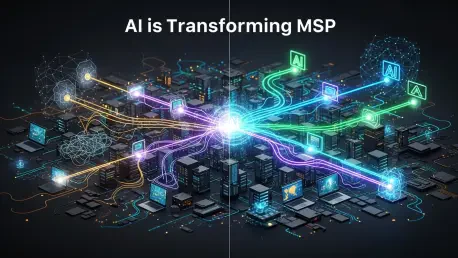

The days of managed service providers operating solely as reactive troubleshooting entities have vanished as the integration of advanced artificial intelligence redefines the foundational expectations of small and medium enterprises. In the current market, approximately nine out of ten client inquiries focus directly on how these organizations can harness generative tools and machine learning to optimize their internal operations. This shift has forced a massive transition within the IT channel, where technical support is no longer a standalone product but a component of a much broader consulting ecosystem. Clients no longer seek just a technician to fix a broken server; they demand a strategic partner capable of mapping out a comprehensive digital roadmap that balances innovation with fiscal responsibility. By positioning themselves as AI consultants, MSPs are finding new ways to add value while maintaining their essential recurring revenue streams and building a future-proof model.
The Foundation of Scale: Unifying the Data Layer
Modern efficiency within a managed service environment relies heavily on the elimination of fragmented, multi-vendor silos that historically hindered rapid response times and accurate data analysis. Instead of juggling disparate software suites that fail to communicate, high-performing providers are now adopting a connected data layer strategy that utilizes API-first architectures to harmonize information. This unified approach allows remote monitoring and management tools to share telemetry directly with documentation platforms and security consoles in real time. When these systems operate on a single source of truth, the ability to automate routine tasks becomes significantly more effective, reducing the manual labor typically associated with incident management. Such a transition allows technicians to focus on high-level advisory tasks rather than getting bogged down by the administrative friction of toggling between inconsistent dashboards, thereby increasing the overall billable potential of the firm.
Beyond simple operational speed, the centralization of anonymized data provides a predictive advantage that was previously unattainable for smaller service providers. By analyzing trends across a vast ecosystem of managed endpoints, artificial intelligence can identify potential system failures or security anomalies before they escalate into critical business interruptions. This proactive posture is the cornerstone of the modern consulting model, as it shifts the MSP from a cost center to a vital business continuity partner. Furthermore, a unified platform ensures that metadata remains consistent across all service tiers, allowing for more accurate reporting and more transparent billing practices. As providers move toward 2027 and 2028, the ability to demonstrate tangible performance improvements through data-driven insights will be the primary differentiator in a crowded marketplace where basic technical proficiency is now considered a commodity rather than a competitive advantage for growth.
Defensive Innovation: Countering the Evolution of Cyber Threats
While the benefits of automation are undeniable, the rapid democratization of sophisticated tools has simultaneously birthed a new era of highly automated and aggressive cyberattacks. Malicious actors now employ large language models to craft perfect phishing campaigns and use brute-force algorithms that can test millions of credential combinations in a fraction of the time previously required. This dark side of technology has turned the digital landscape into a complex battlefield where manual defense mechanisms are increasingly obsolete against machine-speed incursions. To maintain their integrity, service providers must adopt a strategy of fighting fire with fire by embedding defensive artificial intelligence directly into their security stacks. This involves using behavioral analysis to detect lateral movement within a network and automated quarantine protocols that can isolate an infected device the moment an anomaly is detected, effectively neutralizing threats before they can spread.
Technical defense is only one side of the equation; the modern MSP must also ensure that every technological advancement is supported by a rigorous framework of regulatory compliance. Innovation without a strong foundation in standards such as SOC 2, GDPR, or PCI DSS constitutes a significant liability that can lead to catastrophic financial and legal consequences for both the provider and the client. A strategic consultant ensures that data handling practices are transparent and that AI-driven automation does not inadvertently violate privacy laws or industry-specific mandates. By prioritizing these governance structures, service providers can mitigate the risks associated with data mishandling while providing their clients with the peace of mind necessary to embrace digital transformation. This focus on ethical and compliant implementation serves as a crucial check against a move fast and break things mentality, ensuring that the adoption of new technologies remains sustainable.
Strategic Implementation: Practical Steps for Service Providers
Transitioning into a consulting role required a fundamental rethink of internal workflows and a move toward eliminating the operational friction that limited profitability. Providers began by auditing their existing technology stacks to identify redundancies and ensure that every tool was capable of deep integration within a unified data environment. This cleanup process was essential for creating a lean infrastructure that could support the high-demand requirements of AI-driven services without requiring a linear increase in headcount. By automating the boring aspects of IT management, such as patch scheduling, basic ticket categorization, and inventory tracking, staff members were freed up to engage in the high-touch, high-value consulting work that clients now prioritized. This shift not only improved the bottom line through better margins but also enhanced employee satisfaction by replacing repetitive manual tasks with more intellectually stimulating and strategic problem-solving.
Successful practitioners in this space focused on establishing a clear roadmap for their clients that emphasized gradual integration rather than overnight upheaval. They prioritized the development of specialized professional services packages that could be layered on top of existing managed service agreements to capture the new demand for strategic guidance. These providers recognized that the true power of automation lay in its ability to provide clear, actionable intelligence that directly contributed to a client’s business growth. Ultimately, those who thrived were the ones who treated technology not as a final destination but as a flexible tool for achieving specific commercial objectives. By maintaining a focus on security, compliance, and data integrity, they secured their position as indispensable partners in an increasingly automated world. These steps proved that the marriage of technical expertise and strategic consulting was the only viable path forward for organizations in the modern landscape.