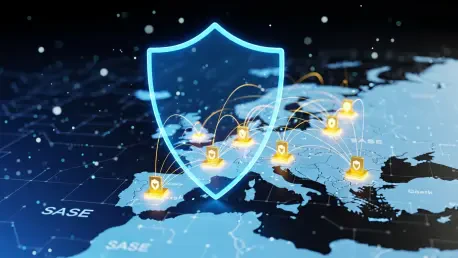

As the global digital economy becomes increasingly fragmented by geopolitical tensions and sophisticated AI-driven cyber threats, European enterprises find themselves caught in a delicate balancing act between technological innovation and strict data privacy requirements. This tension has catalyzed a significant shift toward digital sovereignty, where the control of data and infrastructure is no longer just a technical preference but a strategic necessity for regional stability. Recent collaborative efforts between industry leaders like Zscaler and Schwarz Digits have introduced a sovereign Secure Access Service Edge platform specifically designed to meet these rigorous demands without compromise. This partnership effectively bridges the gap between high-performance cloud security and localized data residency, ensuring that organizations can leverage cutting-edge tools while remaining compliant with national security interests. By integrating a Zero Trust architecture with infrastructure located entirely within German borders, the initiative provides a blueprint for how European entities can navigate the complexities of a hyper-connected world.
Strategic Integration: Sovereign Cloud and Security Frameworks
The alliance between Zscaler and Schwarz Digits represents a fundamental change in how cybersecurity is delivered to the European market, focusing on the concept of being compliant by design. At the heart of this strategy is the use of STACKIT, the sovereign cloud infrastructure provided by Schwarz Digits, which serves as the hosting environment for advanced security services. By ensuring that all data processing occurs within German data centers, the platform effectively shields sensitive information from foreign jurisdictional reach, such as the implications of the U.S. Cloud Act. This localized approach is critical for enterprises that must adhere to the highest European legal standards while pursuing digital transformation in a volatile market. Moreover, it allows organizations to bypass the traditional risks associated with public cloud environments, where data residency can often be ambiguous or subject to international legal disputes. This framework provides a stable foundation for businesses to grow without the constant fear of unauthorized third-party access.
Building on this sovereign foundation, the partnership emphasizes the importance of technological independence as a driver for regional economic resilience. When security services are decoupled from foreign-owned infrastructure, European companies gain a level of autonomy that was previously difficult to achieve in the era of globalized cloud computing. This independence is not merely about physical location; it is about the governance and control mechanisms that allow a company to audit and manage its data flows with total transparency. The integration of specialized cloud expertise with deep-seated knowledge of local regulatory environments creates a synergy that traditional, one-size-fits-all security vendors often struggle to replicate. By prioritizing a Europe-first infrastructure model, this collaboration fosters a more secure and predictable digital ecosystem for industries that are wary of the geopolitical volatility surrounding cross-border data transfers. Consequently, enterprises can focus on their core operations, knowing their underlying security architecture is built on a framework that respects their legal and operational boundaries.
Technical Architecture: Identity-Centric Security in a Borderless World
The technical core of this sovereign offering is the Zero Trust Exchange, a cloud-native platform that fundamentally alters the traditional security model by eliminating the concept of a trusted network. In a conventional setup, once a user is inside the network perimeter, they often have broad access to internal resources, which is a major vulnerability in the face of modern cyberattacks. The Zero Trust architecture replaces this outdated method with an identity-centric approach where no user, device, or application is trusted by default. Instead, every connection request must be continuously verified based on identity, context, and policy before access to a specific application is granted. This granular control is essential for preventing the lateral movement of threats, which is a common tactic used by malicious actors to escalate privileges once they have breached an entry point. By hosting this exchange on sovereign infrastructure, the solution ensures that these complex verification processes are performed locally, maintaining both high performance and strict data residency.
Integrating these security functions into a unified SASE framework allows European organizations to reduce the operational complexity that often plagues large-scale IT environments. Traditional security often involves a patchwork of disconnected tools, from secure web gateways to firewalls, which can create gaps in visibility and increase the administrative burden on security teams. The sovereign SASE platform merges wide-area networking with cloud-native security into a single, manageable system that is both resilient and agile. This consolidation is particularly beneficial for organizations with distributed workforces or complex supply chains, as it provides a consistent security posture regardless of where a user is located. Furthermore, the use of a unified platform enables faster response times to emerging threats, as policy updates and security patches can be deployed globally across the entire architecture with minimal friction. This streamlined approach ensures that digital sovereignty does not lead to technical stagnation, but rather provides a more efficient and secure way to manage modern enterprise networks.
Future Outlook: Toward Sustained Digital Autonomy
The rapid evolution of AI-powered cybercrime has created a new set of challenges that traditional security measures are increasingly ill-equipped to handle today. Modern attackers use automated tools to identify and exploit vulnerabilities with a speed and scale that can overwhelm human-led security teams. The Zero Trust model is particularly effective against these fast-moving threats because it focuses on minimizing the attack surface and isolating individual applications. By ensuring that a compromised account or device cannot be used to traverse the network, the platform effectively neuters many of the advantages that AI provides to cybercriminals. This proactive defense is critical for maintaining operational continuity in an era where cyber disruptions can have significant financial and reputational consequences. Furthermore, the localized nature of the sovereign cloud adds an extra layer of protection, as the data itself remains protected by European laws and encryption standards designed to withstand decryption attempts.
In the final assessment, the integration of Zero Trust principles with sovereign cloud infrastructure provided a concrete solution for the multifaceted challenges facing European organizations. Decision-makers recognized that relying on a security model that prioritized localized control while maintaining global performance standards was the only viable path forward. This initiative empowered companies to move beyond a reactive stance, turning their focus toward long-term digital resilience and strategic autonomy. By choosing a framework that localized data processing and strictly enforced identity-based access, enterprises successfully mitigated the risks of both international jurisdictional overreach and AI-driven intrusions. Stakeholders considered the expansion of these sovereign models into broader supply chains to ensure that every node in the digital ecosystem met the same rigorous security criteria. The transition toward a sovereign SASE environment allowed the public sector and private industry alike to reclaim ownership of their digital destiny.